


3960px Scroll - Extra Slow
Hide Cursor on Scroll




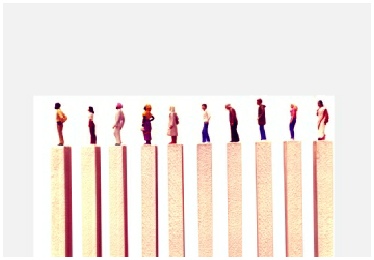
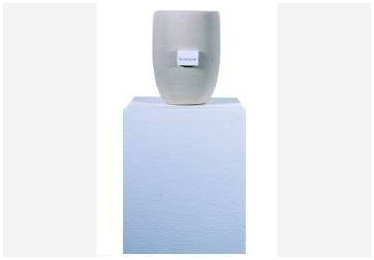

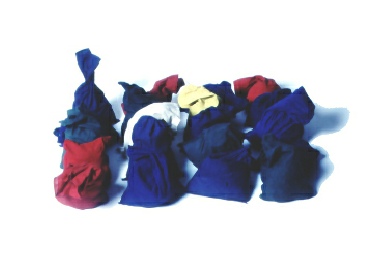


1. Surplus Workers:
Specific groups in society are maintained in a cycle of
poverty, they function to ensure economic stability.
Title Conflict and Consciousness 1996 - 98

MDF | Ceramic | Mounting Board
Money Bags | 40000 Coins (1P)
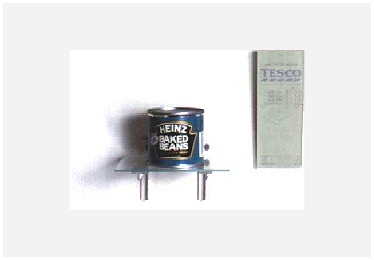
2. To investigate petty crime the artist reflects methods used by specific social groups maintained in a cycle of poverty. The tin of beans has been shoplifted from a supermarket the point is emphasized, as there is no account of the beans on the receipt, the artist selected the smallest tin in the range of Heinz Beans to reinforce the point of pettiness.
3. Working Class Crime/Corporate Crime:
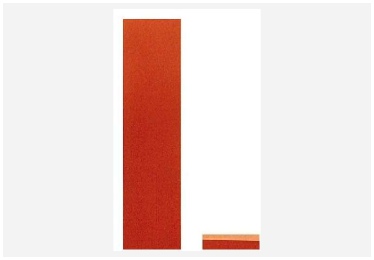
The artist investigates the level of crime in relation to social class within capitalist socio-economic structures.
4. Maintaining Underdevelopment:
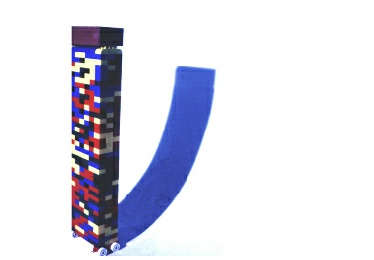
The wheeled structure supporting the brick reflects the technologically and economically advanced. The single brick conveys the inability to develop a condition maintained at a level that is beneficial to developed countries.
5. Untitled:
This piece investigates formal sculptural and economic autonomy and has within the piece an escape route for the artist.
6. Untitled: The central and concluding piece conveys the result of maintaining underdevelopment, for many a lingering death by malnutrition. 40.000 (concealed) pennies reflect our blind nature, ironically using currency, which also represents the cause of a contemporary form of commercially generated genocide.















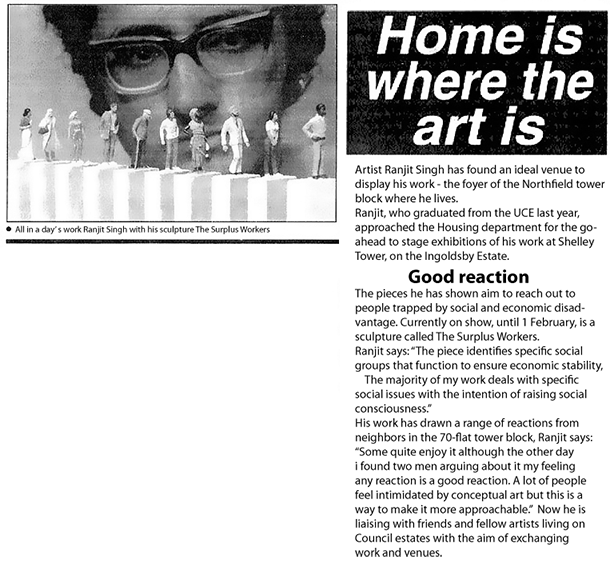

Artist Ranjit Singh has found an ideal venue to display his work - the foyer of the Northfield tower block where he lives. Ranjit, who graduated from the UCE last year, approached the Housing department for the go-ahead to stage exhibitions of his work at Shelley Tower, on the Ingoldsby Estate. The pieces he has shown aim to reach out to people trapped by social and economic disadvantage. Currently on show, until 1 February, is a sculpture called The Surplus Workers. Ranjit says: “the piece identifies specific social groups that function to ensure economic stability, The majority of my work deals with specific social issues with the intention of raising social consciousness.” His work has drawn a range of reactions from neighbors in the 70-flat tower block, Ranjit says: “Some quite enjoy it although the other day I found two men arguing about it - my feeling is that any reaction is a good. A lot of people feel intimidated by conceptual art but this is a way to make it more approachable.” Now he is liaising with friends and fellow artists living on Council estates with the aim of exchanging work and venues.
Metro News Birmingham publication 1999
All in a days work Ranjit Singh with his sculpture The Surplus Workers
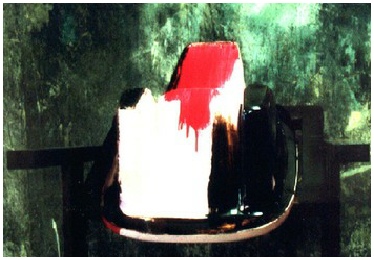
Title Re-distribution of knowledge
Date 2002
By Ranjit Singh

Redistribution of Knowledge
Redistribution of Knowledge deliberately references the political and economic concept of the redistribution of wealth, repositioning the debate around the importance of access to knowledge, education, and critical consciousness. The artist argues that economic redistribution alone remains limited in its effectiveness if individuals and communities are excluded from understanding the systems and processes that shape social and economic conditions. Within this framework, the work suggests that the control, restriction, and manipulation of information are fundamental mechanisms through which global underdevelopment and dependency are maintained.
The project examines the relationship between knowledge, self-sufficiency, and creative production. The artist positions education and access to information as essential tools for empowerment, arguing that without critical awareness, cycles of poverty and social exclusion are merely displaced rather than transformed. Through this perspective, the work critiques structures that preserve inequality by limiting access to cultural, educational, and economic resources.
The artist states: “This piece of art represents a process of self-sufficiency — a method that allows me to use disregarded material (rubbish) from council estates to create art, art that would finance further education and art engagement.” The use of discarded and overlooked materials reflects a broader conceptual interest in reclaiming value from environments associated with neglect, marginalisation, and economic deprivation. The transformation of waste into cultural production functions both as a practical methodology and as a symbolic critique of systems that determine value through economic status and institutional recognition.
The artwork that embodied this methodology was later disposed of following the transfer of the artist’s studio space to a charitable organisation located within Shelly Tower, Northfield, Birmingham, in June 2002. The loss of the physical work further reinforces themes within the practice concerning instability, precarity, and the vulnerability of independent artistic production operating outside institutional structures.
Despite this, the artist maintains that the broader process of producing socially engaged and multifunctional art contributed to the development of a sustainable working methodology. He argues that “The art market is unpredictable; creating diverse and socially inclusive art is rarely popular.” In response to this instability, the artist has undertaken an ongoing process of archiving artworks, concepts, and methodologies through digital formats and online engagement, ensuring the continued accessibility and preservation of the practice beyond the limitations of the physical object or conventional gallery systems.