This project included interviewing individual residents post exhibition.
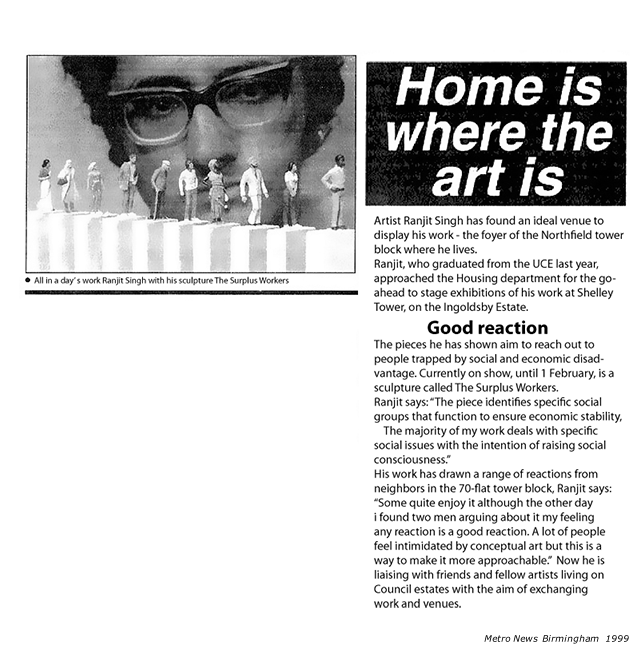
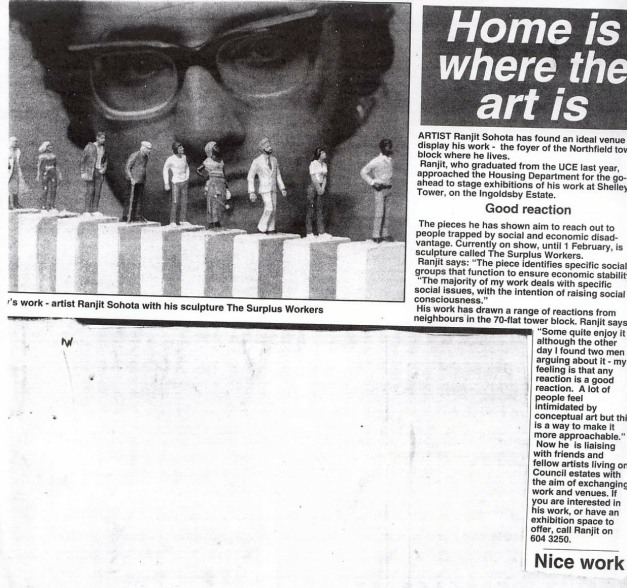
Artist Ranjit Singh has found an ideal venue to display his work - the foyer of the Northfield tower block where he lives. Ranjit, who graduated from the UCE last year, approached the Housing department for the go-ahead to stage exhibitions of his work at Shelley Tower, on the Ingoldsby Estate. The pieces he has shown aim to reach out to people trapped by social and economic disadvantage. Currently on show, until 1 February, is a sculpture called The Surplus Workers. Ranjit says: “the piece identifies specific social groups that function to ensure economic stability, The majority of my work deals with specific social issues with the intention of raising social consciousness.” His work has drawn a range of reactions from neighbors in the 70-flat tower block, Ranjit says: “Some quite enjoy it although the other day I found two men arguing about it - my feeling is that any reaction is a good. A lot of people feel intimidated by conceptual art but this is a way to make it more approachable.” Now he is liaising with friends and fellow artists living on Council estates with the aim of exchanging work and venues.
Metro News Birmingham publication 1999
All in a days work Ranjit Singh with his sculpture The Surplus Workers
Video
5.
Ingoldsby Estate Community Arts Project
Birmingham
Shelley Tower Resident Interview
Date 1999 - 2000
By Ranjit Singh
Ingoldsby Estate, Northfield, Birmingham
Like many post-war council estates in the United Kingdom, the Ingoldsby Estate is physically and symbolically marginalised, set back from main arterial roads and largely absent from public visibility—an embodiment of the “out of sight, out of mind” condition that characterises much social housing. The estate comprises 668 residential properties, approximately 200 of which are privately owned. The population exceeds 2,000 residents and continues to increase due to recent housing developments. Demographically, the estate remains predominantly white and includes a designated residential area specifically for elderly residents.
At present, the community appears socially fragmented and partially depopulated, a condition exacerbated by the ongoing demolition of the estate’s most deteriorated housing stock. The buildings primarily targeted for removal are concrete maisonettes constructed during the 1960s, a period marked by rapid, low-cost housing provision. As with many estates of this era, planning prioritised speed and economy over long-term considerations of social wellbeing, spatial quality, and community cohesion. In this context, the Ingoldsby Estate provides a critical site for examining how the built environment shapes social relations, cultural identity, and the human condition more broadly.
The associated art project operates both as a response to, and an intervention within, this social environment. It is informed by the lived experiences of residents while simultaneously contributing to community engagement through diverse artistic practices. The project positions art as a mechanism for reflection, dialogue, and the reactivation of communal spaces within a landscape undergoing structural and demographic change.
The majority of the artworks have been exhibited on the ground floor of Shelley Tower, which functions as an effective exhibition site due to its high levels of daily footfall. Residents encounter the works organically as they enter and exit the building. Over recent months, the full Conflict and Consciousness series, Desmond Tate, and Cleansing to a Brilliant White have been displayed, alongside paintings by Barbara Walker and Frank MacAleese.
In addition, selected works have been presented at Masefield Hall, the local community centre, during organised community events. The space—made available with the support of local authority employee Martin Griffin—has also hosted training programmes linked to the project. Artists involved in the programme are available for engagement and training sessions upon request, further embedding the project within the social infrastructure of the estate.